Project Planning
- Preconstruction budget and schedule review
- Permitting, inspections and owner reviews tracked to closeout
- Specialty trade partners scheduled, coordinated and supervised by our superintendent
- Closeout records, warranties and as-built drawings delivered with the building
Cut and fill sound like simple arithmetic until a high desert site starts to disagree with the survey. The earthwork quantity on the drawings assumes the ground is the same material all the way down, and in New Mexico it rarely is. A pad that looks like clean sandy fill on the surface can carry a hard layer of caliche a foot below, a soft pocket where an old arroyo once ran, or a slope that was gentler on the topographic sheet than it feels under a scraper.
We treat mass grading as the first real conversation with the site, not as a line item to get through before the building starts. The Albuquerque Basin is a good example of what we mean: it is part of the Rio Grande rift, with elevations inside one city running from about 4,900 feet near the river to more than 6,700 feet in the foothills. Almost every pad in that range is a hillside, a valley floor or a mix of both, and the grading plan has to respect which one it is.
What follows is how we approach earthwork for warehouses, plants, shopping centers and campus sites, and the questions we think an owner should ask before the first blade touches dirt.
What the soil report tells us and what it leaves out
The geotechnical report is the starting document, and we read it with a pencil. We look for the depth to caliche or cemented layers, the swell and collapse potential of the native soil, the groundwater reading if one was taken, and the recommended moisture range for fill. Then we compare the boring locations to the corners of the pad. Borings are spaced for the engineer's budget, not for our scraper, so a site with four holes tells us about four spots and asks us to infer the rest.
When the report and the field disagree, we want that discovered in the first week, not the fifth. Potholing the suspect areas with the excavator before bulk earthwork starts costs a day and tells us whether the cut will rip, hammer or blast. It also tells the owner early whether the cut material is usable as structural fill or has to be hauled off, which is the single largest swing in a grading budget.
Arroyos get their own attention. A dry channel on the survey can carry a real flow during monsoon season, and the plan has to say where that water goes both during construction and after the pad is finished. Our approach to the permanent drainage side is covered in stormwater and drainage work.
Stripping, cut, fill and the fine grade
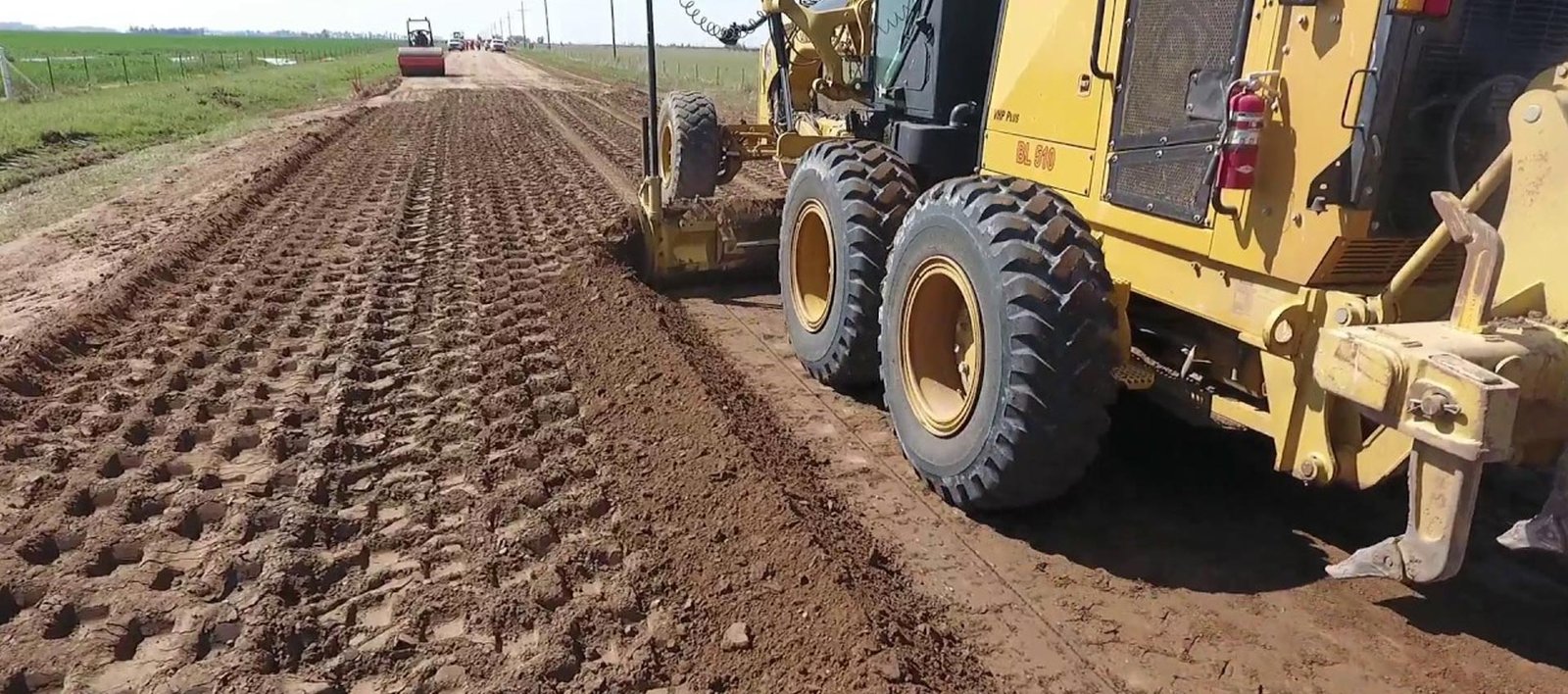
A typical mass grading package starts with clearing and stripping the organic and disturbed topsoil, stockpiling what is worth keeping for landscape areas and wasting what is not. Next comes the bulk cut and fill, worked in lifts that are placed, moisture-conditioned and compacted before the next layer goes on. Thin lifts and steady moisture matter more than machine size; a thick lift that bridges over a soft spot looks fine on the surface and settles under the slab a year later.
Once the pad reaches rough grade we shape the pad edges, the slopes, the detention basins and the access ramps, and we set the subgrade to the tolerance the building needs. A tilt-wall casting slab, a rack-supported warehouse floor and a stucco-clad retail strip each ask for something different from the last few inches of dirt, which is why the earthwork scope and the concrete foundation scope should be written together. Compaction testing runs alongside the placement, not after it, so a failing lift is reworked while the equipment is still on that part of the site.
Fitting earthwork around weather and the permit clock
Grading is the phase most exposed to weather and the phase most often rushed to make a permit date. In the high desert the dry months are the easy ones, but a single afternoon in monsoon season can saturate a half-finished pad and cost a week of drying and rework. We watch the radar and the forecast daily in July and August, and we stage the work so that no large area is left at an unstable intermediate grade overnight when storms are in the forecast.
Sequencing also depends on what has to be approved before the dirt moves. A grading permit, an erosion control plan and any drainage approvals usually come first, and utility locates and relocations can hold up the cut. We build these dependencies into the schedule in preconstruction so the owner sees where the float is. Where a project is heading toward a building permit soon after, our work on permitting and entitlements runs in parallel with the grading rather than behind it.
Where earthwork money actually goes
Hauling distance and material reuse drive most of the number. If the cut can be placed as fill on the same site, the cost stays low; if it has to be exported and replaced with imported select fill, the trucking can exceed the cost of the machines. Rock and caliche are the second driver, because a cut that has to be ripped or hammered runs at a fraction of the production of open soil. Dust control, water for compaction and the number of passes of testing also add up on a large pad.
The third driver is unknowns that were priced as allowances. We prefer to carry a clearly defined unit price for rock excavation and for undercut and replacement, so the owner pays for what is actually found instead of a lump sum padded for fear. That honesty is easier to maintain when we are in the job early, which is one reason owners with large pads often combine this scope with site development and utilities under a single contract.
Large pads from the metro to the border
The demand for big, flat building pads is concentrated where freight and power are. On the west side of the metro, the planned Paseo del Volcan corridor is described in a City of Albuquerque planning brochure as a roughly 30 mile four-lane freeway intended to open thousands of acres for manufacturing, distribution, data center and warehouse facilities. At the state's southern edge, private builders at Santa Teresa have been putting up speculative warehouses of 365,000 and 135,000 square feet, and every one of those buildings begins as a graded pad.
We grade for logistics and distribution operators and speculative developers in both settings, and in the smaller markets between them. If the pad is headed for a distribution use, our work on warehouse buildings and truck courts and dock aprons picks up exactly where the earthwork ends.
Talk through the site before the dirt moves
Send us the survey and the geotechnical report and we will walk the site with you, flag where we expect surprises and put a plain earthwork number in front of you.
Questions Owners Ask
How do you handle caliche or rock found during the cut?
We want it identified before bulk work begins, so we probe the likely areas and compare what we find to the soil report. If it is present, we price it on a unit basis, rip or hammer it as the material demands, and decide with the engineer whether the broken material can go back in as fill. The owner sees the quantity as it is excavated, not as a surprise at the end.
Can we start grading before the building permit is issued?
Often yes, under a separate grading permit, as long as the erosion control plan and drainage approvals are in place. The advantage is that the pad is ready when the building permit lands. The risk is that design changes to the building footprint can force rework, so we usually confirm the footprint and finished floor elevation with the design team before committing to final grades.
What does compaction testing involve and who pays for it?
A testing agency takes density readings on each lift and compares them to the specified percentage of maximum density at the right moisture content. The owner normally engages the testing firm directly so the results are independent, and we schedule the trade crews around the testing so failed areas are reworked immediately. Testing costs are modest compared with the cost of repairing a settled slab.
How do you keep dust and runoff under control on a big open pad?
Water trucks work continuously in dry weather, and we limit the area that is stripped at any one time. Perimeter controls, stabilized entrances and sediment basins are installed before major earthwork starts and checked after every storm. In monsoon season we inspect them each morning, since one downpour can move a lot of soil off a site that was fine the day before.
Is imported fill ever the better choice?
Sometimes it is. If the native material is expansive or too wet to condition economically, importing select fill under the building area can be cheaper than fighting the native soil. We compare the haul and handling cost of both options for the owner and let the geotechnical engineer confirm which is acceptable under the foundation.