Project Planning
- Preconstruction budget and schedule review
- Permitting, inspections and owner reviews tracked to closeout
- Specialty trade partners scheduled, coordinated and supervised by our superintendent
- Closeout records, warranties and as-built drawings delivered with the building
A dry arroyo is a drainage channel waiting for its afternoon. In New Mexico the rain does not fall evenly across the year, it arrives in short, heavy monsoon cells that dump a season's worth of water onto hardpan and pavement in an hour, and every commercial site has to be built knowing that. Stormwater work is where that knowledge gets turned into pipe, channel, pond and inlet.
Near Ruidoso, remnants of Hurricane Dolly brought up to 9 inches of rain on July 26 and 27, 2008, and about 500 structures were damaged with estimates of $15 to $20 million. That is a mountain community and an unusual event, but it shows what the desert can do in two days, and it is the reason we do not treat drainage as a minor item at the back of the plan set.
We build the grading, storm sewer, detention and outfall work that keeps a finished building dry and keeps the neighbors dry as well. The owner's concern is usually the approval and the cost; ours is that the water goes where the engineer drew it, on the first big storm, with nobody watching.
Why drainage decides site layout here
Many municipalities require that a developed site release no more runoff than it did before construction, which means a new parking lot and roof area often need detention or retention on the property. That land is not free. A basin takes space from buildable area, and its depth is limited by the groundwater and the available outfall. The earlier a basin is located and sized, the less it distorts the rest of the plan, and commercial real estate developers who settle it at the concept stage keep more buildable ground.
In the Albuquerque Basin, with ground that runs from about 4,900 feet near the Rio Grande to more than 6,700 feet in the foothills, the direction of surface flow is dramatic and local. Along the valley, acequias and drainage districts add another layer: an irrigation ditch can be both a boundary and an outfall, and the agency that maintains it has opinions about what may be discharged into it. We learn those opinions early, because an outfall that cannot legally be used is a redesign.
Approvals, inspections and the paper behind the pipe
Drainage work touches more agencies than almost any other scope. The municipality or county reviews the drainage report and grading plan; stormwater permitting under the construction general permit can apply when a site disturbs enough ground; a flood control authority or conservancy district may control the receiving channel; and the Construction Industries Division administers the building and utility permits around all of it. The state's 2021 New Mexico Commercial Building Code, adopted under 14.7.2 NMAC and effective July 14, 2023, is the baseline for what is built on the pad, and the roof drains and site plumbing fall under the state plumbing code, which permits under either the 2021 or 2024 edition until January 1, 2027 and only the 2024 edition after.
Our role is to build to the approved plan, keep the inspection record clean and document as-built conditions so the owner can show the basin and outfall match what was approved. Where the approval path itself needs attention, our team handles it under permitting and entitlements.
Pipe, inlets, ponds and channels
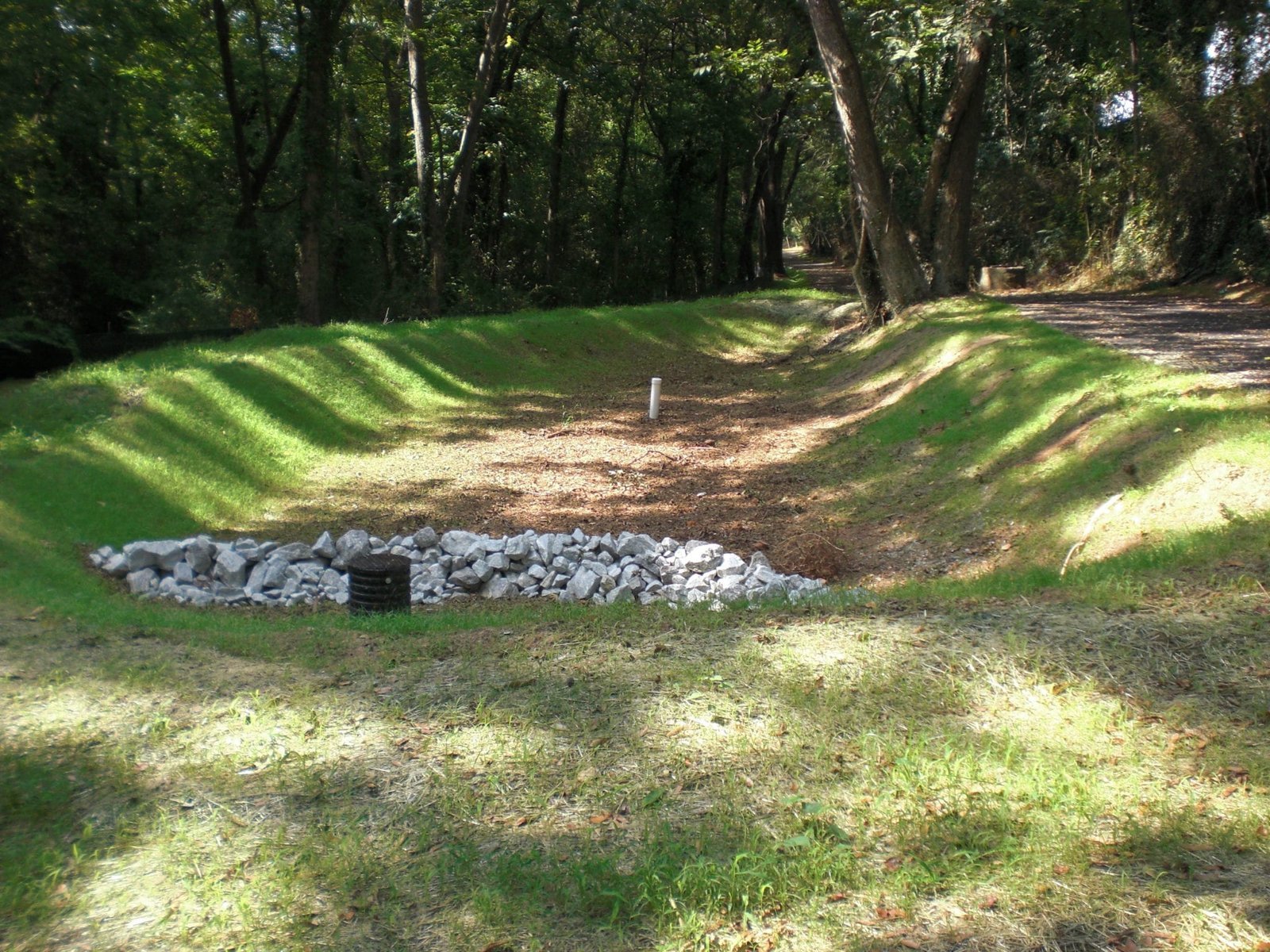
A typical package begins with the storm drain trunk line, set to grade with laser control and bedded to the specification, then the inlets, manholes and headwalls that collect and release the flow. Detention basins are excavated to the designed volume, with outlet structures sized to meter the release rate, and lined or seeded as the plan requires. Channels and swales are shaped and armored with riprap, concrete or vegetation depending on velocity. For a big-box building such as a shopping center, the connection from the roof drain system to the site storm sewer is coordinated with the plumbing trade.
Each element is tested before it is buried. Pipe is inspected for joint tightness and slope, and basins are surveyed to confirm the volume. These checks happen alongside mass grading and before final paving, so the finished surface drains without ponding. We also protect completed structures from construction traffic, since a crushed pipe is far cheaper to repair before the pavement goes over it.
How we keep the water honest during construction
Water does the most damage to a project while it is half finished. We install erosion and sediment controls before major earthwork, build the permanent basins early so they can double as temporary sediment traps, and stage work so that open trenches are not left across a flow path over a weekend with storms forecast. The superintendent checks the controls after any significant rain and repairs them the same day.
We also talk to the people downstream. A neighbor whose lot receives the runoff from the site, or a ditch company that takes the outfall, is a real stakeholder, and a short conversation at the start usually avoids a long dispute later. We listen first, then describe the controls and how we will respond if something fails.
Trenches, confined spaces and flash flows
Deep storm drain trenches are among the most dangerous things on a commercial site, and we shore, slope or box every trench that calls for it, with a competent person on site daily. Large-diameter pipe is set with equipment rated for the loads, and manholes and vaults are treated as confined spaces with the required atmosphere testing and rescue plan.
Weather safety matters too. A basin or channel that is dry in the morning can carry water by evening, so crews stay out of low areas when storm cells are in the forecast, and we keep a warning protocol on every site with a drainage feature. Flood awareness is part of the daily briefing in July and August.
Where drainage meets the rest of the site
Drainage never stands alone. It is tied to the paving design in parking lot construction, to the utility corridors in site development and utilities, and to the building elevations set by the foundation. We coordinate those scopes in one schedule so a late utility does not block the basin, and so the finished grades match.
Owners who want one accountable contractor for the full site package often begin with a conversation about design-build delivery, which lets the drainage engineer and the builder settle basin size and location together before the plan is final.
Plan the water before the pavement
Share your site plan and drainage report and we will walk through the basin, outfall and approval path with you before pricing the work.
Questions Owners Ask
Does every commercial site need a detention pond?
Not every one, but most new developments that add significant impervious area do, because local rules typically limit post-development runoff to pre-development rates. Small infill sites sometimes meet the requirement with underground storage or by paying into a regional facility. The drainage engineer decides which applies, and we price the option the plan specifies.
How long does a drainage approval usually take?
It depends on the jurisdiction and how complete the report is. Plans that arrive with a clear hydrology study and a defined outfall move faster than those that leave questions. We encourage owners to submit the drainage package early, since a comment cycle on drainage can pace the whole grading permit.
What happens if a storm hits before the permanent system is finished?
That is why temporary controls go in first. Sediment basins, check dams and stabilized entrances hold the soil, and we pump or divert water around open work. We inspect after every storm and repair damage immediately, and we keep a record in case an agency asks.
Can the existing arroyo on our parcel be used as the outfall?
Possibly, but arroyos are regulated drainageways and discharging into one usually needs the agency's agreement and sometimes a design that slows the release. We help gather the survey and flow information the engineer needs. If the arroyo cannot take the flow, the plan shifts to additional detention or a different outfall.