Project Planning
- Preconstruction budget and schedule review
- Permitting, inspections and owner reviews tracked to closeout
- Specialty trade partners scheduled, coordinated and supervised by our superintendent
- Closeout records, warranties and as-built drawings delivered with the building
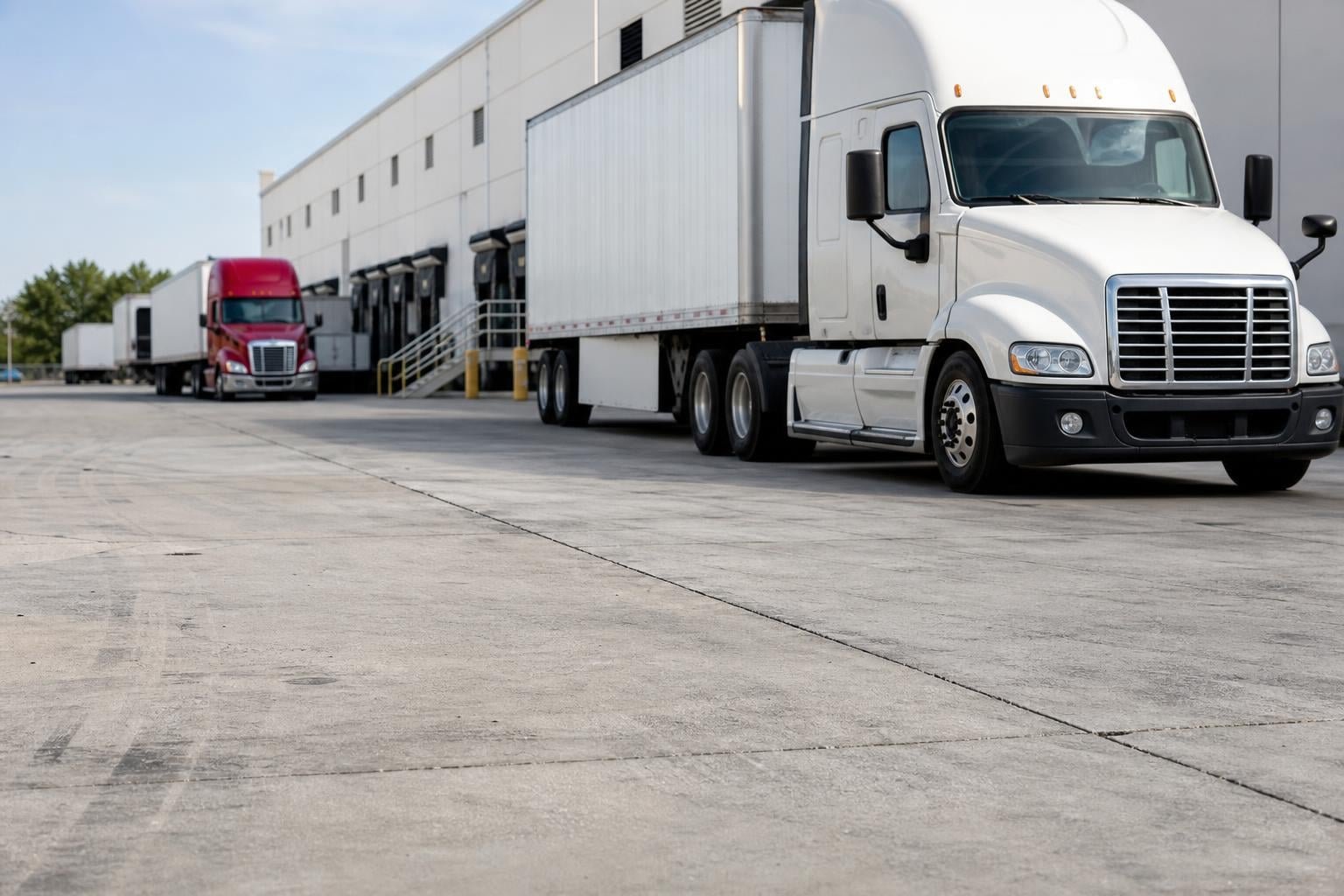
Ask a trucker what makes a distribution site good or bad and the answer is almost never the building. It is the yard: the turn into the gate, the room to back in, the slope at the dock, the pavement under the landing gear. A well-laid truck court makes a facility fast and safe, and a poorly laid one becomes the thing every driver complains about.
New Mexico sits on freight routes that run through the middle of the continent. At Santa Teresa, a New Mexico Border Industrial Association presentation lists a Union Pacific intermodal terminal with 74,000 feet of trackage expandable to 145,000 feet and 1,266 container and trailer parking stalls expandable to 4,380. Trailers move in and out of places like that all day, and the pavement they park on takes loads that an ordinary parking lot never sees.
We build truck courts, dock aprons, trailer storage and drive aisles for warehouses, cross-dock terminals and manufacturing plants, using concrete where wheel loads concentrate and asphalt where they do not. What follows is how we decide, and how we build.
Yards for warehouses, terminals and plants
The yard follows the building. A cross-dock terminal needs doors on both sides, a wide apron and minimal dwell for trucks, as described in our work on truck terminal and cross-dock facilities. A distribution center needs staging, queuing and trailer parking in proportion to its throughput, which we plan together with the distribution center layout. A manufacturing plant may need a smaller court but with more complex turning for oversized loads.
The rail adds another layer. In Clovis, BNSF operates a division point and large freight classification yard on its Southern Transcon, with more than 100 mostly intermodal freight trains arriving and leaving daily. Sites near a yard like that, or near the Santa Teresa rail park, often connect rail spurs, transload areas and truck courts into one logistics system, and the civil design has to handle all of them.
Pavement, joints and the dock edge
A truck court starts with the subgrade and base, built to a strength that carries repeated heavy axles. Concrete pavement is then placed in panels with dowels at joints and a thickness set by the engineer for the expected truck volume. Dock aprons get the heaviest treatment because trailers sit with landing gear down on a small footprint, so we build dolly pads, reinforced concrete slabs designed to take that point load without punching through. Where the apron meets the building, we detail the dock levelers, bumpers and drains so water leaves the dock instead of entering it.
Surface slopes are limited so a parked trailer does not creep, yet drainage must be sufficient to avoid ponding. We shape the grade with laser control, then place and finish the concrete to hold that slope. Trailer stalls are laid out to trailer width with room between rows for a driver to open a door and for a yard truck to pass. Lighting, camera and gate conduits are placed before the pavement so nobody has to cut a new slab to add them. Striping, wheel stops, bollards and signage go in last.
Rules that shape the yard
The yard geometry is set by local site-plan review: access points, driveway widths, truck turning templates and sometimes limits on queuing on public streets. State highway departments may need to approve driveways onto state routes. Fire access and fire lane requirements apply, and the 2021 New Mexico Commercial Building Code, which took effect July 14, 2023 under 14.7.2 NMAC, sets building-side requirements around loading docks and exits.
We help owners through that review, usually with the civil engineer. When we are involved early, we can test truck-turn templates against real vehicle dimensions, which often saves the cost of adding pavement that is never used. Items that look minor on a plan, such as a radius at a corner, can decide whether a 53-foot trailer can enter at all.
Why freight yards are growing here
Freight moves through New Mexico on interstates, rail and air. The Albuquerque Sunport reported 83,355,710 pounds of cargo in 2025, and the interchange of I-25 and I-40 at the Big-I places the metro at the junction of two of the region's main trucking routes. In the south, the Santa Teresa port of entry, the Gateway Rail Park and the Santa Teresa Southern Railroad form a cross-border logistics cluster.
Owners building here tend to ask for more trailer parking than the first plan shows. Retail chains and regional distributors expect their yard to handle peak seasons, not the average week, and a court that is sized only for normal volume becomes a bottleneck. We encourage planning room for expansion, even if the pavement is built later.
Building the yard around the building
Pavement is often one of the last major activities, but the base should be completed earlier so the building trades can use it as a staging area. Concrete trucks, cranes and steel deliveries are hard on a base course, so we protect it or reconstruct it before paving. Concrete paving needs a cure period before it takes loaded trucks, which feeds into the owner's move-in date.
For projects with a tight opening date, we phase the court so the dock apron and the first part of the yard are finished first. Work with mass grading and with parking lot construction is scheduled together, so one paving contractor and one set of controls serve the whole site.
Plan the yard with the trucks in mind
Give us your fleet and throughput numbers and we will help you size the court, choose the pavement and price it.
Questions Owners Ask
Should a truck court be concrete or asphalt?
Concrete holds up better under standing trailers, braking and turning loads, and it resists the fuel and hydraulic fluid that soften asphalt. Asphalt costs less up front and is easier to patch. Many sites use concrete at the dock apron and turning areas and asphalt in lighter-traffic lanes.
What is a dolly pad?
It is a thickened or reinforced concrete section under where a parked trailer's landing gear rests. Without it, the small steel feet can punch into the pavement, especially in summer heat. Dolly pads are usually placed in rows of trailer stalls and at the dock.
How much room do trucks need to turn?
It depends on the trailer length and the angle of approach, but a 53-foot trailer needs far more room than most plans first show. We test the layout against standard truck turning templates early and adjust corners, aprons and depth before the design is final.
How do you handle drainage in a large paved yard?
Pavement is sloped to inlets or to a controlled edge, and the water goes to detention. The slopes are kept gentle at docks. We coordinate with the stormwater design to keep the yard dry without creating a safety problem.
Can the court be built in phases?
Yes. Many owners pave the dock apron and the first trailer stalls and add more parking as demand grows. The initial design should leave room, utilities and drainage capacity for the later phase.