Project Planning
- Preconstruction budget and schedule review
- Permitting, inspections and owner reviews tracked to closeout
- Specialty trade partners scheduled, coordinated and supervised by our superintendent
- Closeout records, warranties and as-built drawings delivered with the building
Most parking lots fail from the bottom up, long before the surface shows it. A lot that looks fine at ribbon cutting starts to rut at the drive aisles in its third summer because the base was thin, or alligator cracks at the trash enclosure because the subgrade was wet when it was paved. By the time the owner sees the damage, the cause is under three or four inches of asphalt and cannot be fixed with a sealcoat.
For that reason we begin every parking lot in the ground, with the soils, the drainage and the traffic that will use it, and we leave the striping for last. A lot behind a clinic and a lot beside a distribution building are different pavements, even if they look alike on a site plan.
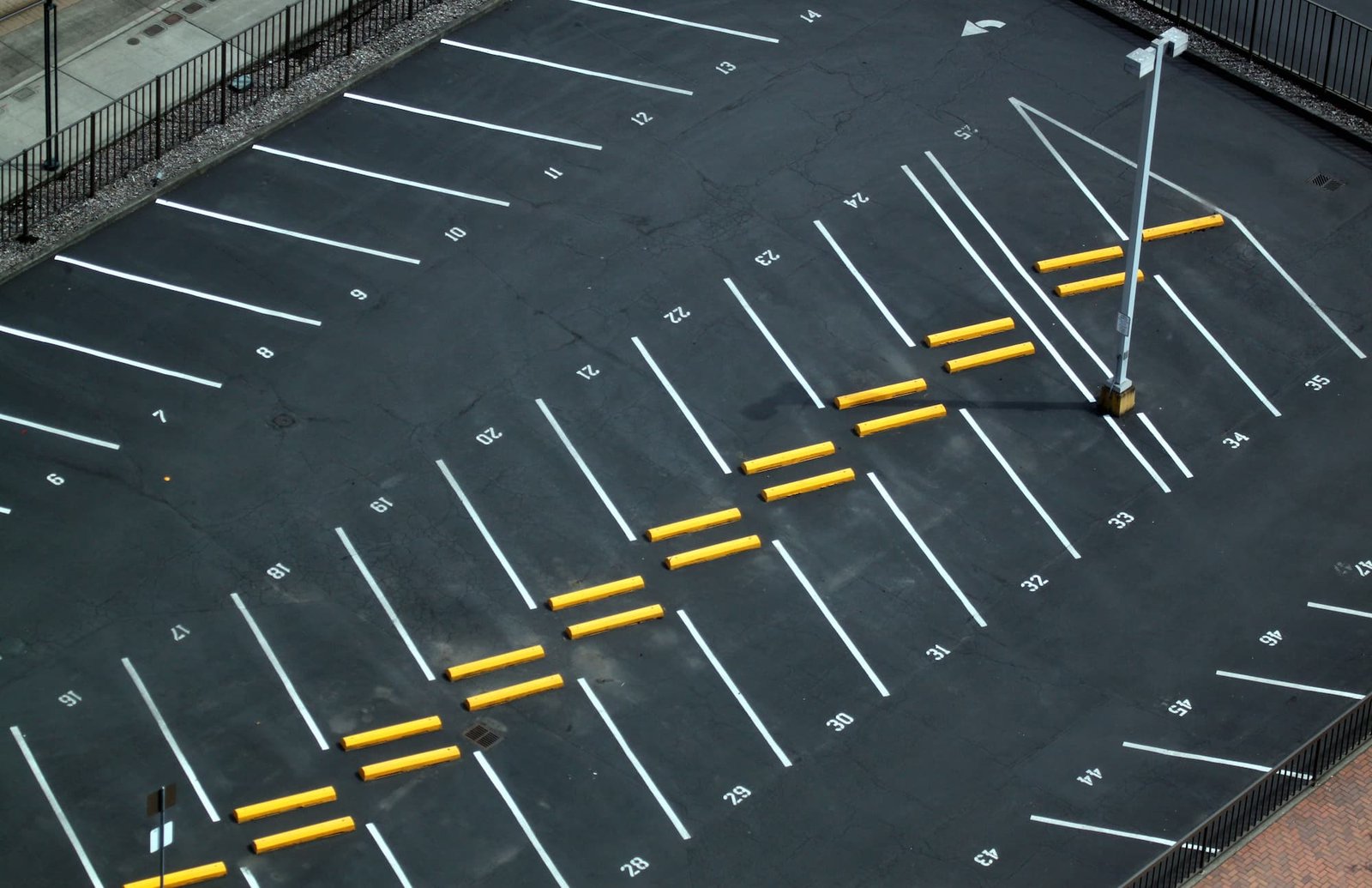
We build new lots for shopping centers, medical campuses, schools, hotels and industrial sites, and we reconstruct tired ones for owners who have outlived a repair strategy. The sections below describe how we think about the work, from the design to the dollar.
Base, subgrade and the loads the lot will carry
A pavement design takes the subgrade strength from the soil report, the expected traffic from the owner, and the climate, and produces a section of base course and surface. The load is the part owners most often underestimate: a retail lot that receives delivery trucks and trash haulers needs a much stronger section in the service lanes than in the stalls. We ask early where the heavy vehicles will travel and make sure the design shows it.
Climate matters as well. Gallup sits at an elevation of 6,647 feet, a place where freeze and thaw cycles and snow removal wear on a pavement; lower valleys like Las Cruces, at about 3,908 feet, push the stress toward summer heat and softened asphalt. A mix designed for one setting can fail in the other, so we use the mix and binder suited to the site elevation.
Building it so it lasts
The quality of a lot is mostly the quality of the preparation. We proof-roll the subgrade and correct soft spots before any stone is placed, compact the base in lifts to the specified density and trim it to tight tolerance so the asphalt is placed at a uniform thickness. Paving is done in temperatures and conditions that allow proper compaction, with joints staggered and sealed, and we avoid placing hot mix over a base that is wet or frozen.
We take care with drainage too, because water is the enemy of a pavement. Slopes are set to move water to inlets, ponding areas are removed in the grading stage, and edges are detailed so water does not seep into the base. Our team coordinates this closely with stormwater and drainage so the finished lot works with the site's detention and not against it.
Asphalt, concrete and the cost over time
Asphalt is cheaper to place and easier to repair, which is why most stalls and light-duty lanes use it. Concrete costs more up front but lasts longer under heavy and turning loads, so it fits trash enclosures, bus lanes and dock aprons. The right answer for many owners is a mix of both, with concrete where the loads are heavy and asphalt elsewhere. We price alternatives so the owner can compare first cost to life-cycle cost.
Quantities of base stone, haul distance and the amount of subgrade correction drive most of the variance. Site conditions such as a high water table or soft soil can add large amounts of undercut. Striping, signage, lighting and landscaping islands add cost that often gets underestimated in early budgets. Owners such as property management firms should also plan the maintenance cycle, since crack sealing and seal coating on schedule extends the life considerably.
Accessibility, fire access and approvals
A parking lot has to satisfy accessibility rules for the number and placement of accessible stalls, routes and ramps, as well as zoning requirements for stall count, landscaping and lighting. Fire access lanes and turning radii are reviewed by the local fire marshal. Because the New Mexico Commercial Building Code, 14.7.2 NMAC, adopts the 2021 International Building Code as amended and took effect July 14, 2023, the accessibility provisions the lot's connection to the building falls under are those of that edition.
We build to the approved plans and layout accessible stalls and curb ramps with tight tolerances, because slopes that miss the maximum by a small amount are a common reason for rework and failed inspections. Photos and as-builts are recorded at each step.
Retail pads, airport lots and growing suburbs
Parking is the most visible part of a growing commercial corridor. In Rio Rancho, Mayor Gregg Hull told a March 2025 NAIOP roundtable that the city had seen $6 billion in investment over ten years, with the Unser Gateway area drawing new retail, housing and commercial pads. Each of those pads needs a lot. Rio Rancho projects tend to be pad-by-pad, so we stage work to keep neighboring businesses open.
Public lots have their own demands. Santa Fe Regional Airport completed a terminal expansion and new parking lots between 2022 and 2024, and projects like that run with security, passenger access and phasing concerns that private lots rarely see. Santa Fe work also faces design review that shapes lighting, screening and materials, an area where we move carefully and listen to the board. Our retail shopping center and self-storage construction teams build many of the lots that go with those projects.
Traffic control and working beside open businesses
Parking lot work usually happens next to customers, so traffic control is the safety issue. We lay out phasing so that part of the lot stays open, mark pedestrian routes with barricades and signage, and keep equipment away from entrances at opening times. Paving is hot, heavy work, and trade crews follow heat illness controls, spotters for backing trucks, and clear separation between pavers and pedestrians.
Night work is sometimes the best way to reconstruct a busy lot. We light the work area well, brief the crews on the night plan and coordinate with the property manager so tenants know what to expect in the morning.
Get the lot right from the base up
Send the site plan and tell us how the lot will be used, and we will outline a pavement section and a price you can compare.
Questions Owners Ask
How long should a new parking lot last?
A well-designed and well-built asphalt lot can serve for many years with regular crack sealing and periodic seal coating or overlays, and concrete sections last longer. Life depends on the base, drainage, traffic and maintenance. We provide a recommended maintenance schedule when we turn the lot over.
Can you repave a lot while the businesses stay open?
Yes. We split the work into sections so customers always have access and parking, close one area at a time and communicate with tenants beforehand. Night paving is sometimes the right call, especially for busy retail lots.
Why does water pond in some lots after rain?
Usually because the grades were set too flat or settled after construction. We survey the base before paving and set slopes with enough fall for water to move to inlets. Ponding is far cheaper to fix on the base than on finished pavement.
What is the difference between a mill and overlay and full reconstruction?
A mill and overlay removes the worn surface and places new asphalt, which suits pavements with a sound base. Full reconstruction removes the base too, and is needed when the base has failed or drainage must be changed. We test and core the lot before recommending either.
Do you handle striping and accessibility layout?
Yes. We lay out stalls, accessible spaces, ramps, crosswalks and signs to the approved plan and verify slopes before and after paving.