Project Planning
- Preconstruction budget and schedule review
- Permitting, inspections and owner reviews tracked to closeout
- Specialty trade partners scheduled, coordinated and supervised by our superintendent
- Closeout records, warranties and as-built drawings delivered with the building
Taking a building down is mostly an exercise in knowing what is inside it. The structure may be simple, but the paint, the insulation, the floor tile, the roofing, the transformer in the corner and the tank under the slab each carry a rule about how they must be handled, and the rules decide the order of work.
New Mexico has recent examples of why this matters. PNM said on September 30, 2022 that the last unit of its coal-fired San Juan Generating Station near Farmington had been removed from service, following Units 2 and 3 in 2017 and Unit 1 in June 2022. Retiring an industrial plant of that kind raises the questions every demolition faces on a smaller scale: who owns what, what is hazardous, what can be recycled and how the land will be used afterward.
We demolish commercial buildings, remove interiors ahead of renovation, clear sites for new construction and take down damaged structures after fires and floods. Our approach is methodical and unhurried, because the fastest demolition is the one that avoids surprises.
Surveys, notifications and permits
Before a wrecking machine moves, a licensed inspector surveys the building for asbestos-containing materials, lead-based paint and other regulated substances. If any are found, they are removed by licensed abatement crews and disposed of properly, and regulatory notifications are filed ahead of time. Utilities are located and disconnected with the providers, and meters and services are capped. A demolition permit is issued by the local building department, and a contractor performing demolition holds a license class that covers it. Under 14.6.6 NMAC, the GB-98 General Building classification covers erecting, altering, repairing or demolishing residential and commercial buildings and certain structures.
We assemble this paperwork for the owner, track it through approval and keep it on the project file. A single missing notification can stop a job, so the checklist is read twice before a crew starts.
Controlling dust, falling material and structural collapse
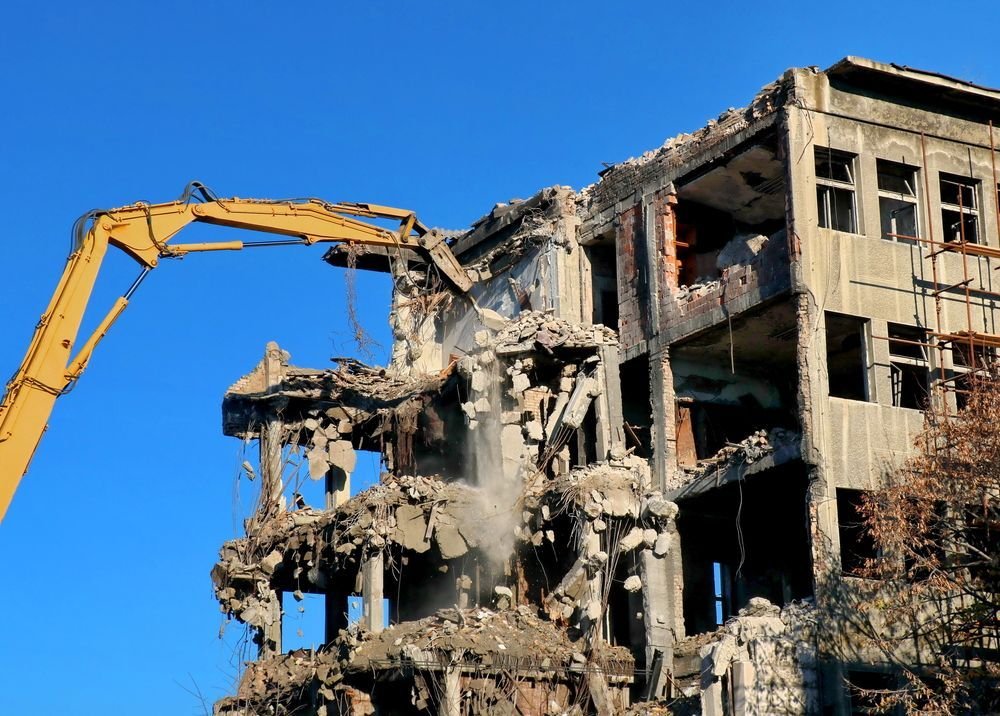
Demolition is among the most hazardous construction activities, and we plan it that way. An engineering survey identifies the structural system and the order in which members can be removed safely. Exclusion zones keep people clear, and spotters watch the machine operators. Water is used to control dust throughout, especially in dry, windy conditions, and we monitor wind and stop when gusts make the work unsafe.
Adjacent buildings are protected with shoring, barriers or vibration monitoring where needed. Workers receive training on silica, lead, noise and heat, and we require respirators, hearing protection and hydration plans appropriate to the job. The superintendent holds a short safety meeting each day and updates the plan as the building comes apart.
From interior strip-out to site clearing
Selective interior demolition removes finishes, ceilings, partitions and sometimes structural elements, leaving a shell ready for renovation. Full demolition takes the building down to the slab or below, removes foundations as required, backfills and compacts the site and restores grades. Sometimes a portion of a building is saved, and then the cut line, the shoring and the weather protection for the remaining structure are the main design issue.
Debris is sorted. Concrete and masonry are crushed for base material when allowed, metals go to recyclers, wood and drywall are separated and hazardous waste is manifested to a licensed facility. After the building is down, we coordinate with mass grading and site development and utilities so the cleared site flows directly into the next phase.
Fire damage, flood damage and industrial sites
Disaster demolition has its own conditions. The South Fork Fire, first reported on June 17, 2024, burned 17,569 acres near Ruidoso and destroyed more than 1,400 structures. Burned structures may be unstable, ash can contain contaminants, and burn scars increase flood risk, so crews need extra care and protective erosion controls. Owners and agencies working in communities like Ruidoso have to manage debris removal at scale while respecting the rights of property owners.
Industrial and mining-era sites bring different issues. Uranium ore found near Haystack Mesa sparked a mining boom around Grants that lasted until the 1980s, and old industrial properties in the region may carry contamination that must be assessed before a building comes down. We coordinate with environmental consultants when a site calls for it and follow their direction on handling soil and debris. Retired power and process plants, like those manufacturers sometimes inherit, need a clear map of equipment, tanks and utilities.
What demolition costs and why
The main cost drivers are the building's size and construction type, the amount of hazardous material, access for equipment, the distance to disposal and recycling facilities, and what the owner wants left behind. Concrete and steel structures take more effort than wood frame ones, but they also produce more recyclable material, which can offset some of the cost.
We price demolition with clear exclusions and unit prices for unknowns such as buried tanks, unmapped utilities and extra abatement. That way the owner knows how the number changes if we find something. Early surveys are the best way to reduce risk, and they pay for themselves by narrowing the range.
Across the state, including small river towns
We work in both large cities and small communities. In places like Truth or Consequences, where several hot springs are located within the city, demolition near sensitive ground and old plumbing calls for extra care with excavation and fill. In Grants, former railroad and mining infrastructure can leave old foundations and buried utilities. Hauling distances in rural areas affect cost, so we plan disposal and recycling routes early.
Where demolition is part of a larger conversion, our renovation and adaptive reuse team works with the demolition crew to define exactly which parts of the building stay.
Know what is inside before it comes down
Send the address and any past survey, and we will arrange a walk-through, outline the hazardous material work and price the demolition with clear allowances.
Questions Owners Ask
Do I need an asbestos survey before demolition?
In most cases yes. Regulations require a survey before demolition or major renovation of most buildings, and the results determine what must be removed before the structure comes down. We can coordinate the survey with a licensed inspector.
How long does a demolition take?
A small building may come down in days, while a large structure with abatement and recycling can take weeks or months. The longest part is often the paperwork and abatement before the machines arrive.
What happens to the debris?
Concrete, masonry, metal, wood and other materials are sorted and recycled where facilities exist. What cannot be recycled goes to a permitted landfill, and hazardous waste is handled by licensed facilities with documentation.
Can you demolish part of a building and keep the rest?
Yes, with careful planning. A structural engineer defines the cut line and any temporary bracing, and we protect the remaining part from weather and vibration. Selective demolition takes more time per square foot than complete removal.
What about buried tanks and utilities?
We locate utilities before starting and use ground-penetrating methods when records are poor. If a buried tank is found, work stops in that area and the proper removal procedure and agency notifications are followed.