Project Planning
- Preconstruction budget and schedule review
- Permitting, inspections and owner reviews tracked to closeout
- Specialty trade partners scheduled, coordinated and supervised by our superintendent
- Closeout records, warranties and as-built drawings delivered with the building
Some boring logs tell a plain story: firm soil from the surface down, a footing that can be sized on a napkin. Others read like a warning. Loose sand over cemented layers, soft silt over rock, expansive clay that swells in the wet months and shrinks in the dry ones. When the log turns that way, the answer is usually to stop asking the surface soil to carry the building and reach down to something that can.
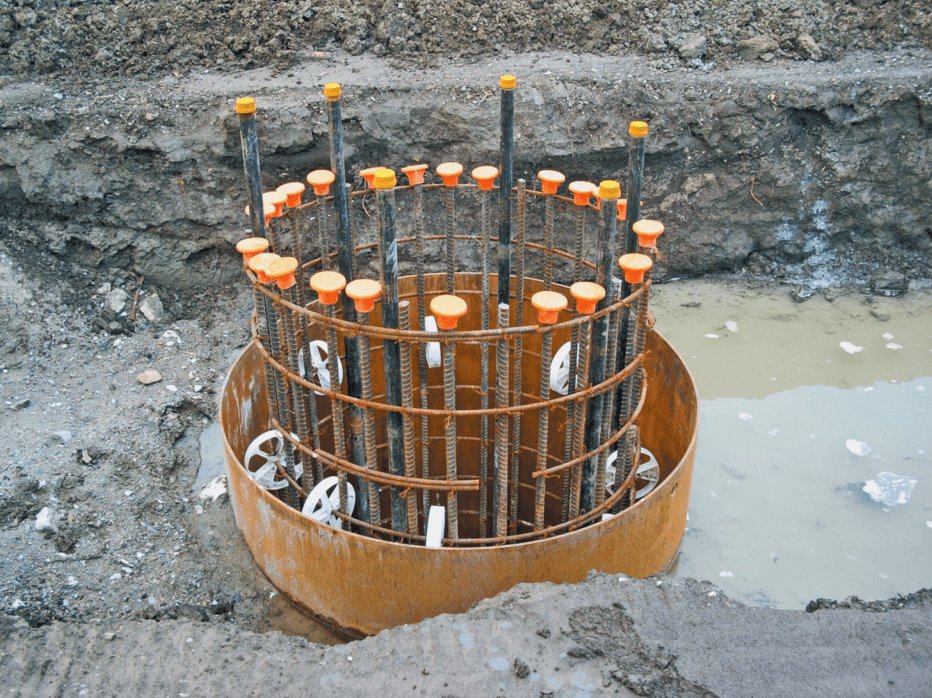
A drilled pier does exactly that. A rotating auger, sometimes with a casing and sometimes with a rock bit, bores a round shaft to the depth the engineer calls for. A reinforcing cage is lowered in, concrete fills the hole, and a column of concrete now carries load past the weak ground to the competent layer below.
We build deep foundations for the heavier and more settlement-sensitive buildings in New Mexico: data halls, process plants, hospital towers, large pre-engineered metal buildings with crane loads. Pier work is often a small fraction of a project's cost and a very large fraction of its risk, and the point of this page is how we manage that risk.
Ground conditions across the rift and beyond
The Albuquerque Basin is part of the Rio Grande rift, a valley bordered by a system of faults that lifted the Sandia and Manzano Mountains and lowered the ground where the river flows. The practical result for a builder is a deep fill of alluvial sediment that varies a lot over short distances, with a mix of sands, gravels and finer layers, and a river that sits below most of the benches. That is the setting in which many of the state's larger facilities are built.
Consider what has gone up on this kind of ground lately. Intel opened Fab 9 in Rio Rancho on January 24, 2024 as part of a $3.5 billion advanced packaging investment, and the investment supported over 3,000 construction jobs. A building like that is sensitive to vibration and settlement, and the foundation conversation begins long before the first rig arrives. Deep foundations are one of the tools used to give such a structure a stable base.
Drilling, casing, cage and concrete
A drilled pier package begins with survey layout of each shaft and a review of the geotechnical recommendations for diameter, depth, rock socket length and allowable bearing. The drill rig bores the shaft, with temporary casing or slurry used to hold the hole open where soils cave. Spoils are hauled away or stockpiled for reuse as determined in the plan.
Before concrete goes in, the bottom of each shaft is cleaned and inspected, and a prefabricated reinforcing cage is lowered with spacers to maintain cover. Concrete is placed with a tremie or a drop chute depending on whether the hole is dry or wet, and casing is withdrawn as the concrete rises. Tops of piers are cut to elevation and tied into grade beams, pile caps or column pedestals, which is where the work connects to the rest of the foundation system described in concrete foundations.
What can go wrong and how we plan for it
Caving soil, groundwater, obstructions and rock harder than expected are the usual problems. Each has a known response: casing or slurry for caving soils, pumped or tremie placement for water, coring or special tooling for obstructions, and a rock bit or core barrel when the socket reaches stone. We confirm the right tooling with the driller before mobilization, because a rig built for soil will not make progress in cemented material. Owners in the public sector often ask for a pier alternate in the bid documents, and we price it beside the spread footing so the comparison is honest.
We also pay attention to neighbors. A drill rig is loud, and the vibration and spoil piles affect adjacent properties. On infill sites with existing structures nearby, a pre-construction survey of adjacent buildings is cheap insurance. In Los Lunas, where a data center campus has grown to more than 4 million square feet with seven operating buildings and three under development by July 2025, heavy mechanical loads make this kind of foundation planning routine for the next building in line.
Who drills and who pours
Drilling is specialized, and we work with licensed drilling contractors whose rigs and crews are matched to the site conditions. What we manage is the coordination around them: layout, cage fabrication and placement, concrete ordering, tie-in carpentry and grade beam work. Keeping those pieces in our hands means the driller is never waiting on steel or concrete, which is where most delay on a pier job comes from.
Our superintendent is present for every shaft. The superintendent records depth, material encountered, groundwater and concrete volume against the theoretical, and compares them with the geotechnical engineer's expectations. When a shaft takes more concrete than it should, that is a signal that something below the surface needs attention, and we want to see it the same day.
Open holes, heavy rigs and suspended cages
An open shaft is a fall hazard, and a drill rig is a heavy machine working near people on uneven ground. Every open shaft is covered or barricaded when not being worked, exclusion zones are marked around the rig, and spotters are assigned when the rig or the crane moves. Reinforcing cages are lifted with rated rigging and set in place by trained crews; no one stands beneath a suspended cage.
Where the design calls for people to enter a shaft for inspection, we follow the confined space rules and the engineer's requirements, which in most cases means inspecting from the surface with camera and probe instead. Daily briefings cover the rig's swing radius, the traffic route for concrete trucks and the weather.
How piers fit the critical path
Piers come early, and they set the pace for everything above. A drill rig can complete several shafts in a day under good conditions, but the schedule must allow for inspection and for concrete to gain strength before columns or pile caps load it. The foundation tolerances needed for steel erection and for data center construction are tight, so surveys follow each pour and the as-built report goes to the engineer before the next trade is released.
We lay out the drilling sequence so the rig works away from freshly poured shafts and so the concrete trucks have a path in. On sites with other activity such as utilities and mass grading, we sequence mass grading so the pad is stable enough for the rig.
Bring us the boring logs
If a geotechnical report has pointed your project toward deep foundations, send it over and we will outline the pier plan, the risks and the schedule.
Questions Owners Ask
When is a drilled pier a better choice than a spread footing?
When the soil near the surface is too weak, too variable or too expansive to carry the load without excessive settlement. A pier reaches a stronger layer and also resists uplift in swelling soils. The geotechnical engineer recommends it, and the cost difference is weighed against the settlement risk of the building above.
How long does it take to install the piers on a typical building?
It depends on the number, diameter and depth. A rig can install several shafts a day in favorable soil, but rock sockets, casing and groundwater slow production a great deal. We give a schedule once the geotechnical report and structural plans are in hand, and we build in time for inspection and concrete strength gain.
Who inspects the shafts?
A special inspector hired by the owner or the engineer observes drilling and placement, records depth and bearing material, and verifies the reinforcing cage and concrete. Our superintendent keeps parallel records so the two sets can be compared. Any variation from the plan goes to the engineer before the shaft is poured.
Do drilled piers affect neighboring buildings?
They can, through vibration and ground movement, though drilled piers are generally gentler than driven piles. On tight sites, we survey adjacent structures before starting and monitor during drilling. A quiet conversation with neighbors beforehand also helps.